

Summary: website analysis
A website analysis examines how well your website performs: whether your tracking is right, whether you are found, how fast your pages are, where visitors drop off and whether your content builds trust. A good analysis does not end with a score, it ends with a list of improvements that bring more enquiries or sales. That is needed: in 2025 only 48% of mobile websites had good Core Web Vitals, according to the Web Almanac 2025. At Game-changers you get a free analysis, with no set-up fee. Request a free analysis.
- Speed: 48% of mobile websites and 56% of desktop sites had good Core Web Vitals in 2025.
- Why it matters: 0.1 second faster gave retail sites 8.4% more conversions, according to research by Deloitte and Google.
- Pitfall: Home pages score worse than other pages: 45% against 56% on mobile.
- Our advice: Start with your tracking and your key pages, not with a general score.
What is a website analysis?
A website analysis is an examination of the technology, findability, speed and visitor behaviour of your website. You want to know what your site delivers now and what to improve to get more customers. According to Ahrefs, Dutch people search 500 times a month for “website analyse” (website analysis), 800 times for “website check” and 1,100 times for “seo analyse” (SEO analysis). There are roughly three kinds:
- SEO analysis or SEO check: checks whether Google can find and read your pages and rates them well for your customers’ keywords.
- Technical audit: looks at speed, errors, mobile display and security.
- Conversion analysis: looks at where visitors drop off and why they do not get in touch or buy.
Most checks online only do the first or the second. A full analysis combines all three, and starts with whether your tracking is right. Without good data and tracking you do not know which pages bring in customers.
How many websites are fast enough?
Google measures the user experience of a page with the Core Web Vitals: load time of the largest element (LCP, good is 2.5 seconds or less), responsiveness (INP, good is 200 milliseconds or less) and layout stability (CLS, good is 0.1 or less). That is explained on web.dev. According to the Web Almanac 2025 by HTTP Archive, 48% of mobile websites passed all three standards, up from 36% in 2023. On desktop it was 56%.

Why speed makes money
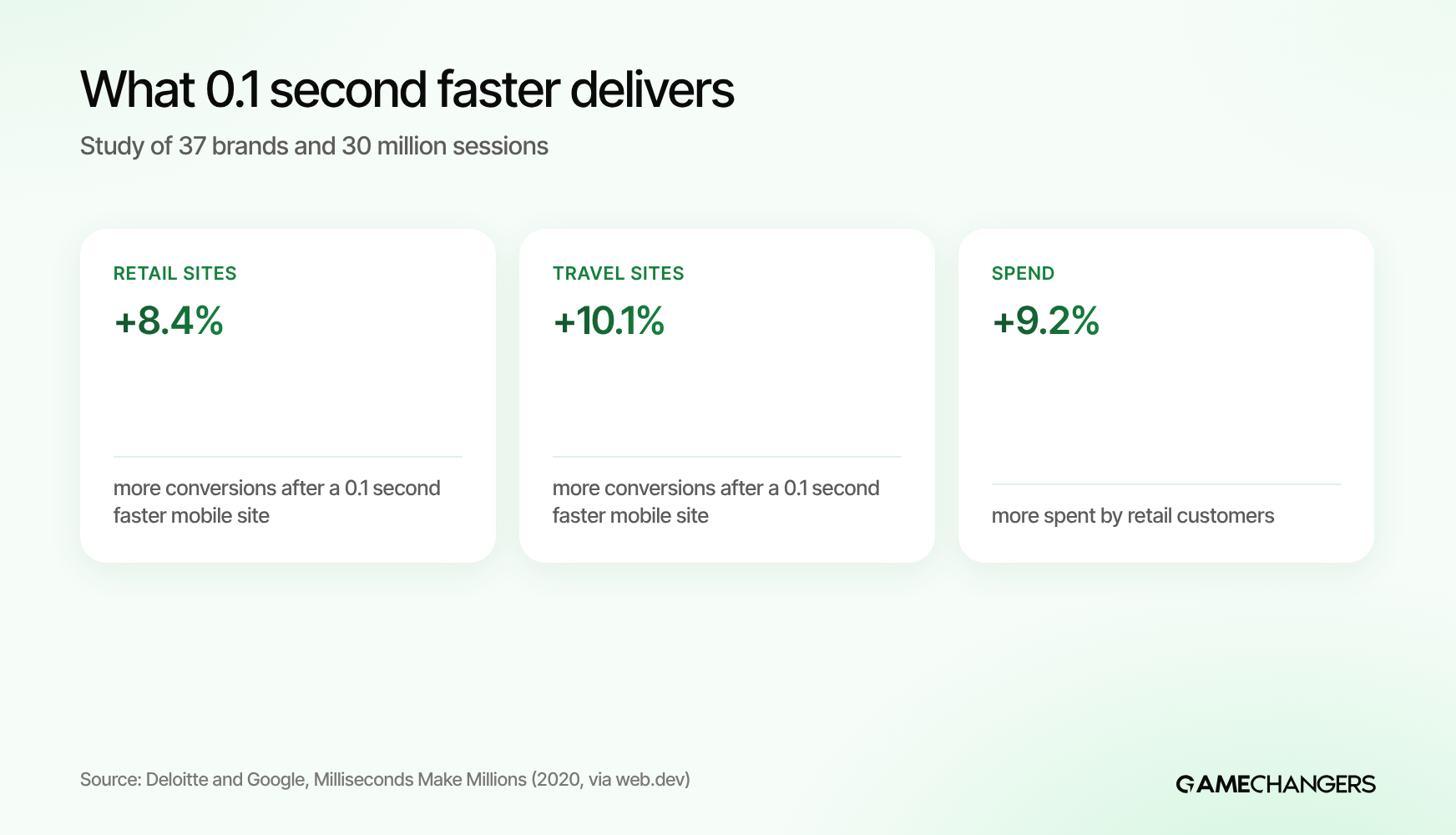
A faster site brings more customers. In the study Milliseconds Make Millions by Deloitte and Google, described on web.dev, 37 brands and more than 30 million sessions were tracked. A mobile site that loaded 0.1 second faster gave retail sites 8.4% more conversions and travel sites 10.1% more. Retail customers also spent 9.2% more. The study dates from 2020, but it shows how small a difference already counts.
Your home page does not tell the whole story
Many people only test their home page. That gives a distorted picture. According to the Web Almanac 2025, 45% of home pages had good Core Web Vitals on mobile, against 56% of other pages. On desktop it was 47% against 61%. Home pages often have large images, sliders and scripts, which makes them slower.

Our research: what Google shows for “website analyse”
On 9 November 2026 we looked at the Dutch search results for “website analyse” (website analysis) with DataForSEO. At the top is a Google AI answer, followed by 9 regular results. What stands out:
- 6 of 9: results are a tool or a list of tools.
- 3 of 9: are in English, although the searcher types Dutch.
- 0 of 9: mention conversion or customers in the title or description.

So almost all results are about technology and scores. That is useful, but it does not answer the question that matters: does your website bring in customers, and if not, why not?
How do you do a website analysis?
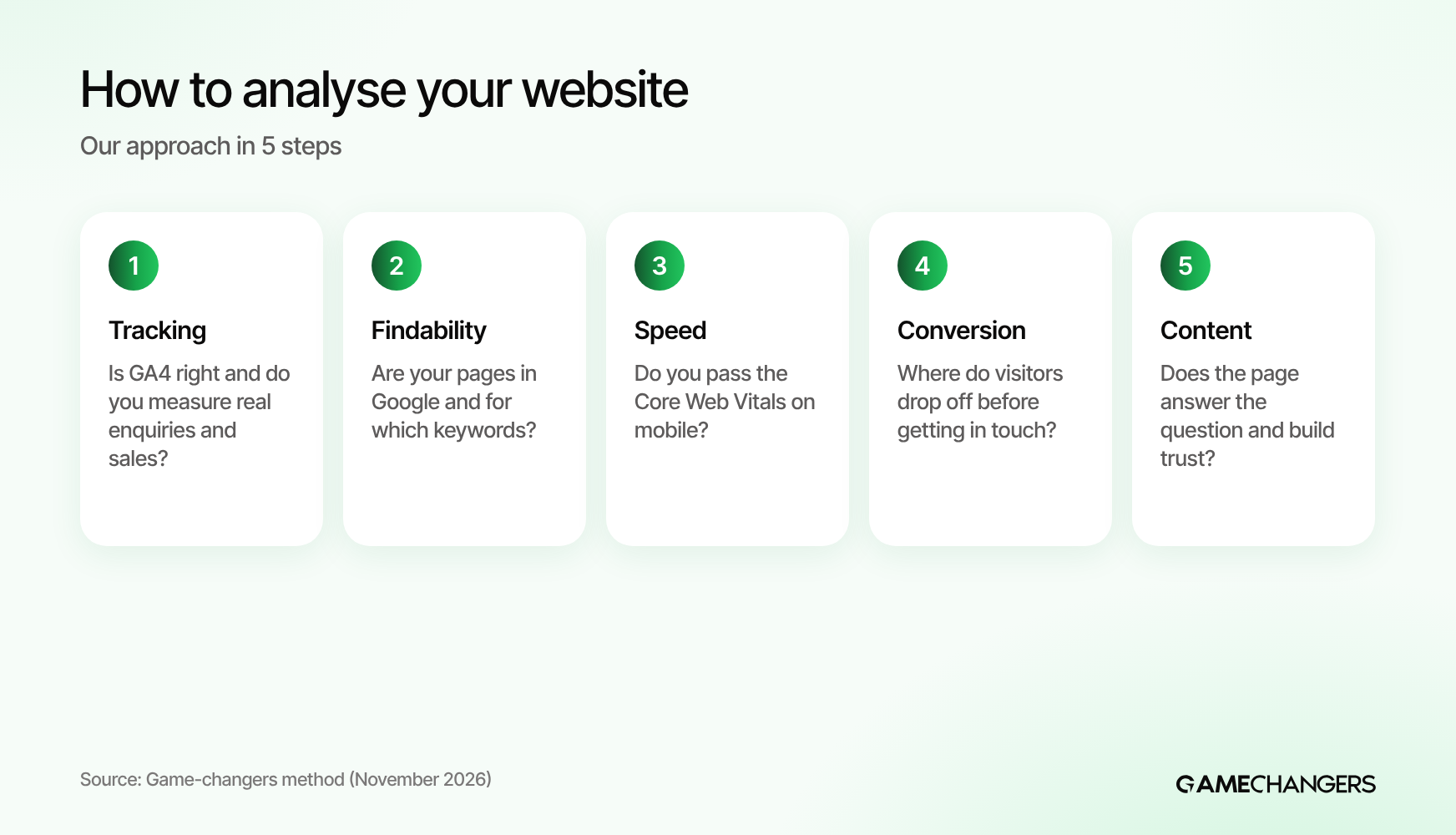
We always work in the same order. That way you avoid spending time on improvements that deliver nothing.
1. Tracking
Check whether GA4 works and whether you measure real enquiries, calls and sales. Without that basis you cannot compare anything. Our tracking and GA4 checklist helps you with this.
2. Findability
Look in Google Search Console at which pages are in Google, which keywords they appear for and how often they are clicked. Pages with many impressions but few clicks are a quick opportunity.
3. Speed
Test your key pages on mobile with PageSpeed Insights. Look at the Core Web Vitals of real visitors, not only at the test score.
4. Conversion
See where visitors drop off. With heatmaps and session recordings you see whether they find your button, fill in your form or give up halfway.
5. Content
Read the page as a customer. Is the answer at the top, is there proof such as reviews and figures, and is the next step clear? Use our landing page checklist as a checklist.
Free tools for a website analysis
You can examine a lot yourself with free tools. We use these four ourselves in every analysis:
Google uses the Core Web Vitals as part of page experience, writes Google Search Central. A fast page is no guarantee of a high position, but it does help when your content is as good as someone else’s.
What it delivers
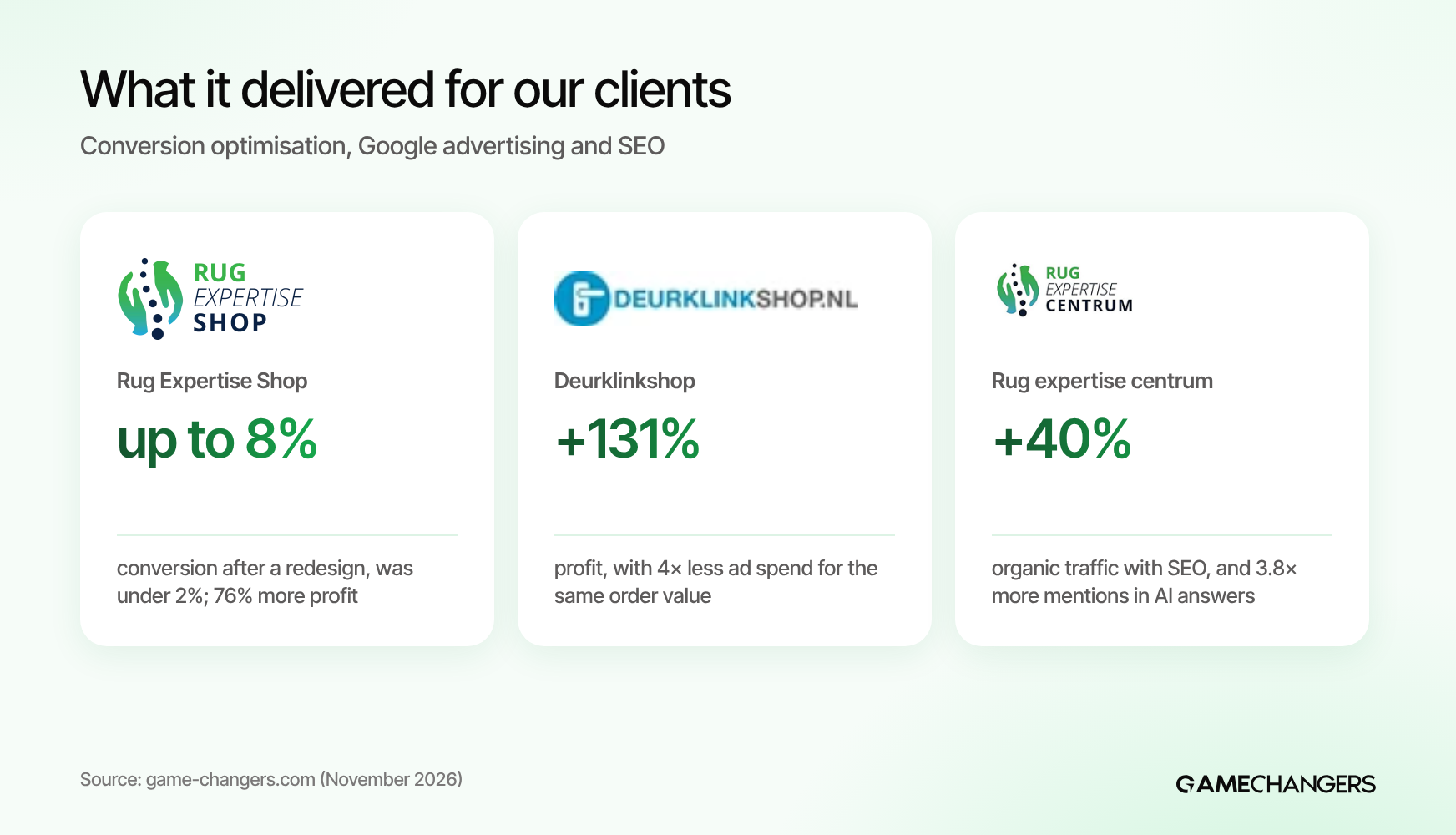
An analysis is only valuable if you act on it. Rug Expertise Shop went from under 2% to up to 8% conversion after a redesign based on conversion rate optimisation, with 76% more profit. Deurklinkshop achieved the same order value with 4 times less ad spend, with 131% more profit. Rug expertise centrum gained 40% more organic traffic with SEO and AEO (also called AI SEO) and is mentioned 3.8 times more often in AI answers.
“In a website analysis most people look at a score from a tool. We first check whether your tracking is right and which pages bring in customers. Only then do you know which improvement is worth the most money. A fast home page says little if nobody gets in touch through your service page.”

Analyse it yourself or have it analysed?
At Game-changers conversion rate optimisation starts from €500 per month excl. VAT, for which we work at least 4 hours per month for you. Data and tracking is included as standard. There is no set-up fee. Request a free analysis. Combine it with SEO and AEO and it becomes cheaper. Want to know what SEO costs first? Read our explanation.
Frequently asked questions about website analysis
What is a website analysis?
A website analysis is an examination of the technology, findability, speed and visitor behaviour of your website. The aim is to see what your site delivers and what to improve for more enquiries or sales.
How do you do a website analysis?
Work in five steps: check your tracking, look at your findability in Google, test the speed, find where visitors drop off and assess the content. Start with the pages that bring in customers, not with the home page.
What does a website analysis cost?
With free tools it only costs you time. At an agency the price differs per offer. At Game-changers the first analysis is free, with no set-up fee. Request a free analysis.
How good is my website?
You can tell from three things: whether you are found for your customers’ keywords, whether your pages are fast enough and how many visitors get in touch or buy. A score from one tool only tells part of that.
What is an SEO analysis?
An SEO analysis examines whether Google can find, read and value your pages properly. You look at technology, keywords, content and links. It is part of a full website analysis.
How do I do a website SEO analysis?
Start in Google Search Console: which pages are in Google, for which keywords and with how many clicks. Then look at titles, content and internal links, and test the speed with PageSpeed Insights.
What is the difference between an SEO check and a website analysis?
An SEO check only looks at findability in Google. A website analysis also looks at tracking, speed, conversion and content. You then see not only whether you are found, but also whether visitors become customers.
What does an SEO audit mean?
An SEO audit is a thorough check of everything that affects your findability in Google, such as technology, content and links. The word audit is often used for an extensive, technical analysis.
Can I have my website analysed for free?
Yes. With Google Analytics 4, Google Search Console, PageSpeed Insights and Microsoft Clarity you can examine a lot yourself for free. At Game-changers you can also request a free analysis, with no set-up fee. Request a free analysis.
How do you test your website’s speed?
Use Google’s PageSpeed Insights and test your key pages on mobile. Look mainly at the Core Web Vitals of real visitors, because Google uses those for page experience.
What are Core Web Vitals?
Core Web Vitals are three Google measurements of user experience: load time (LCP), responsiveness (INP) and layout stability (CLS). In 2025, 48% of mobile websites passed all three standards.
How fast should a website load?
The largest element of your page should be visible within 2.5 seconds; that is the standard for a good LCP. Every tenth of a second counts: 0.1 second faster gave retail sites 8.4% more conversions in research by Deloitte and Google.
How often should you analyse your website?
Do a full analysis at least once a year, and after every major change such as a new design or a migration. Your tracking and key figures are best checked every month.
Why does my website not bring in enquiries?
Usually for one of three reasons: the wrong visitors, a slow or unclear page, or a difficult form. An analysis of your tracking and visitor behaviour shows where it goes wrong.
How do you see how many visitors your website has?
You see that in Google Analytics 4, in the reports on acquisition and pages. Do check that your tracking is set up properly, because a wrong setting can count visitors twice or not at all.
What does conversion optimisation cost at Game-changers?
From €500 per month excl. VAT, with at least 4 hours of work per month and data and tracking included as standard. There is no set-up fee. Request a free analysis.
Sources
HTTP Archive, Web Almanac 2025, Performance chapter
15 January 2026
web.dev, Milliseconds make millions (Deloitte and Google)
2020, viewed 9 November 2026
viewed 9 November 2026
Google Search Central, Understanding page experience
viewed 9 November 2026
viewed 9 November 2026
viewed 9 November 2026
DataForSEO SERP API, own measurement Google Netherlands
9 November 2026
Ahrefs Keywords Explorer, Dutch search volume
9 November 2026
Over de auteur
About the author
Annefleur van Osta
Online marketing strateeg bij Game-changers. Schreef dit artikel en houdt de prijzen en bronnen actueel.
Online marketing strategist at Game-changers. Wrote this article and keeps the prices and sources up to date.