
Summary: what is the difference between SEO and GEO?
SEO vs GEO comes down to one question: do you want a click from Google, or a mention in an AI answer? SEO (search engine optimization) gets your website ranking high in Google, so people click through. GEO (generative engine optimization) gets AI assistants such as ChatGPT, Perplexity and Google AI Overviews to mention your business in their answer. The foundation is the same: a technically sound website, strong content and trust. The difference is in the goal and in what weighs most. With GEO, mentions on other sites, your Google Business Profile and direct answers with numbers count for more, and you measure mentions instead of rankings. So you don’t have to choose: good SEO is the foundation of GEO. At Game-changers we do both together, from €500 a month excl. VAT.
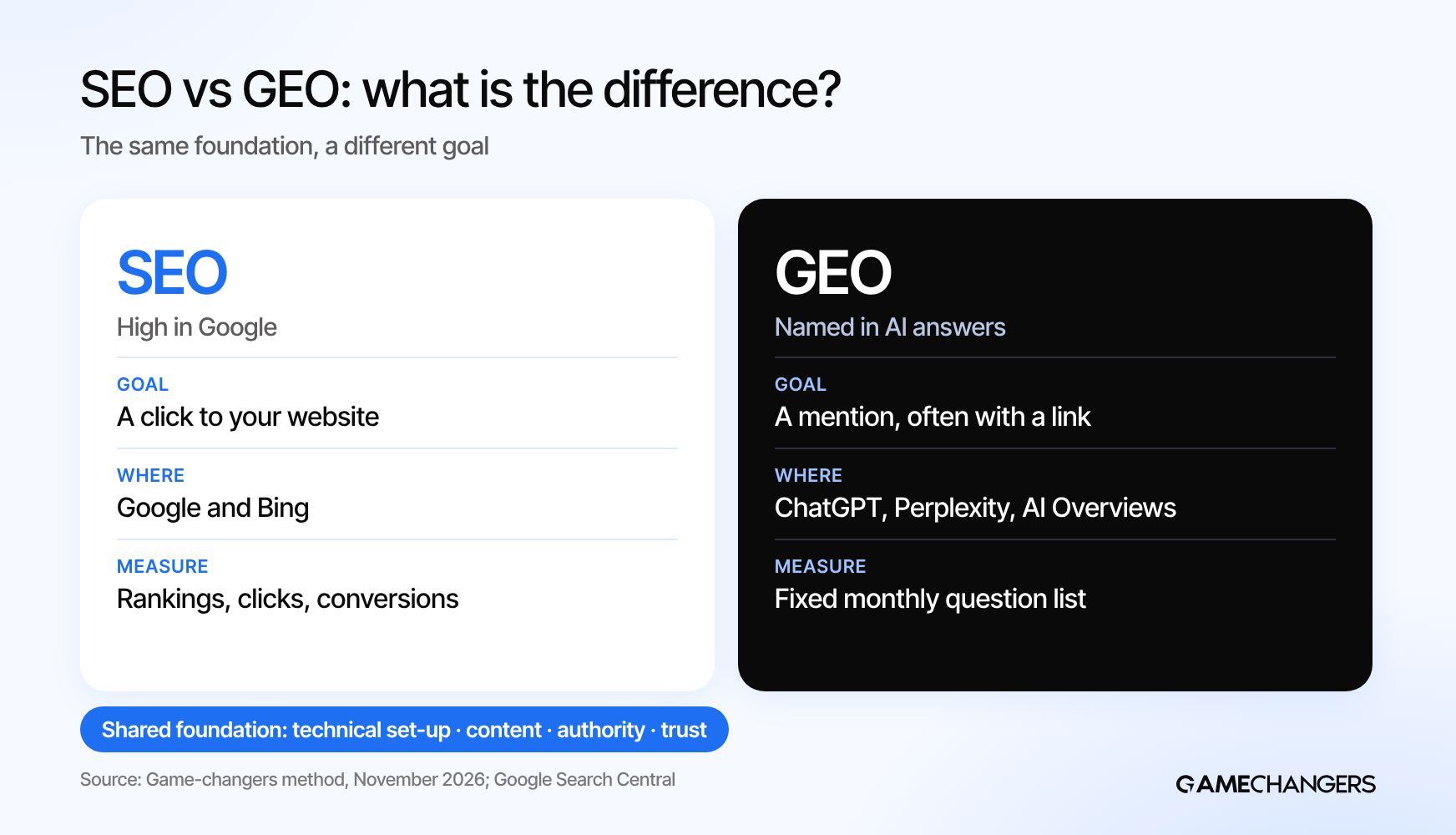
- SEO: Goal: a high position in Google and a click to your website. Measure: rankings, clicks and conversions.
- GEO: Goal: being named and linked in AI answers. Measure: how often AI assistants mention you for a fixed set of questions.
- What they share: Technical set-up, content that answers questions, authority and trust. Google itself says no separate optimization is needed for AI Overviews.
- Our advice: Start with SEO and your Google Business Profile, then add GEO: mentions on other sites and monthly measurement in AI assistants.
The difference between SEO and GEO in one table
This is how we compare the two. The table shows where the difference lies, and where it doesn’t.
What SEO and GEO have in common
Google is clear about it. Its guidance on AI features says no special optimization is required to appear in AI Overviews and AI Mode. A page must be indexed and eligible to show with a snippet in Google, and the usual SEO fundamentals still apply. ChatGPT also relies on the open web: OpenAI writes that sites that block its search crawler OAI-SearchBot will not be shown in ChatGPT search answers.
We see the same with our clients. For Rug expertise centrum we built one content engine in which experts review every article. That delivered 40% more organic traffic from Google and 3.8 times more citations in AI answers. The same work, two results.
- Technical set-up: A fast website that Google and AI crawlers can read, with structured data.
- Content: Pages that answer your customers’ questions directly and completely.
- Authority: Links and mentions from other sites, and customer reviews.
- Trust: Clear about who you are, where you are, what you cost and who wrote the text.
Where GEO is really different
On four points we approach GEO differently from regular SEO.
1. What others say about you weighs more
When we asked Perplexity which agency it recommends, it based its answer on list articles, review sites and comparison platforms. If you are not on them, you are not mentioned, however good your own site is.
2. Your Google Business Profile is a source
In our test ChatGPT named 38 agencies and linked each one to its Google Maps listing, with rating and number of reviews. A complete profile with reviews is both local SEO and GEO.
3. You write for questions, not keywords
In AI assistants people ask full questions. According to DataForSEO, “wat kost seo” (what does SEO cost) is asked about 482 times a month in AI assistants in the Netherlands, against 40 times in Google. A direct answer with a number and a source is more likely to be used.
4. There is no position 1
You don’t measure rankings but how often you are mentioned. The GEO research by Princeton and others (KDD 2024) measured it the same way, and found that changes to your text can raise visibility by up to 40%.
Read how to tackle this step by step in our complete guide to getting found in ChatGPT.
What do Dutch people search for: SEO or GEO?
We checked in Ahrefs how often people in the Netherlands search for both topics in Google each month (9 November 2026).
- SEO is still much bigger: “seo” is searched almost ten times as often as “generative engine optimization”. Google remains the main source of visitors for now.
- GEO is no longer a niche: Together the GEO terms are already searched thousands of times a month, and that excludes the questions people ask ChatGPT directly.

Our research: what the Dutch top 10 for “verschil seo en geo” tells you
On 9 November 2026 we reviewed the first ten Dutch Google results for “verschil seo en geo” (difference between SEO and GEO). One result was a video, so we judged 9 text pages on eight points.
- Everyone agrees: GEO builds on SEO: All 9 pages say so. That matches our experience, and Google says it too.
- Not a single page shows a result: Nobody shows what GEO delivered for a client. That is why our figures for Rug expertise centrum and Healthcenter Vennewater are below.
- Only 5 of the 9 mention the Google Business Profile: Yet in our test ChatGPT took every recommended business from there.

“Clients often ask us whether they now have to choose between SEO and GEO. You don’t. Everything you do well for Google also helps in ChatGPT. The difference is in the last step: get others to write about you and measure whether AI assistants actually mention you.”

Where to start: SEO or GEO?
Our advice depends on where you are now. This is the order we follow.
- You barely show up in Google yet: Start with SEO: technical set-up, one clear page per service and answers to your customers’ questions. Without that foundation, an AI assistant has nothing to point to.
- You are a local business: Start with your Google Business Profile: address, categories, photos and above all reviews. That works for Google Maps and for ChatGPT in one go.
- You already rank well in Google: Add GEO: get mentioned on review sites, comparison sites and in your industry, write direct answers with numbers and measure every month whether AI assistants mention you.

Measurement is half the work for both. Read how we set it up under Data & Tracking.
What SEO and GEO delivered together for our clients
- Rug expertise centrum: 40% more organic traffic and 3.8 times more citations in AI answers, from one content engine in which experts review every article.
- Healthcenter Vennewater: From one keyword in the top 20 to more than 20 keywords in the top 5, and number 1 in Google Maps in its own area. A strong local profile is exactly where ChatGPT gets its recommendations.
Read more about our approach on the SEO and AEO (also called AI SEO) page.
What do SEO and GEO cost at Game-changers?
At Game-changers we do SEO and GEO together, from €500 a month excl. VAT. For comparison: Dutch agencies charge €500 to €3,000 a month for SEO on average, according to Trustoo (November 2026). Read what SEO costs exactly and what it depends on in SEO costs in the Netherlands in 2026. What GEO providers charge is in our price research: what does GEO cost.
- Free 30-minute call: We discuss your business, your customers and where you stand in Google and in AI assistants.
- Free 8-hour analysis: We measure your rankings in Google and your mentions in ChatGPT and Perplexity, and you get a report with an action plan. Even if you then do it yourself.
- Free start period: You see how we work before you pay.
- No set-up fee: We don’t charge separately for the technical basics for SEO and GEO.
- Engagement from €500 a month excl. VAT: Your contact is always a senior partner or the founder. Your website, your profiles and your data stay yours.
Book a free call or see what we do for local businesses.
Frequently asked questions about SEO and GEO
What is the difference between SEO and GEO?
SEO gets you ranking high in Google, so people click through to your website. GEO gets AI assistants such as ChatGPT and Perplexity to mention you in their answer. The foundation is the same, but with GEO mentions on other sites, reviews and direct answers with numbers weigh more.
Does GEO replace SEO?
No. GEO builds on SEO. Google itself says no separate optimization is needed for AI Overviews, and ChatGPT uses pages from the open web. Without good SEO, GEO has little effect.
Do I have to choose between SEO and GEO?
No. Start with the SEO basics and your Google Business Profile, and add GEO once you rank well in Google. Much of the work helps both at once.
What is AEO?
AEO stands for answer engine optimization. It means almost the same as GEO: setting up your content so a system uses your text as its answer. It is searched about 800 times a month in the Netherlands.
How do I measure GEO?
Every month, ask ChatGPT, Perplexity, Gemini and Google the same 20 to 30 customer questions, and note whether you are named, which source the assistant uses and whether there is a link.
What do SEO and GEO cost?
Dutch agencies charge €500 to €3,000 a month for SEO on average (Trustoo, 2026). At Game-changers we do SEO and GEO together, from €500 a month excl. VAT, with no set-up fee and a free analysis up front.
Sources
Google Search Central: AI features and your website
Updated 10 December 2025. Viewed 9 November 2026.
Google Search Central: SEO Starter Guide
Viewed 9 November 2026.
OpenAI: Overview of OpenAI Crawlers
OAI-SearchBot and ChatGPT search answers. Viewed 9 November 2026.
Aggarwal et al.: GEO: Generative Engine Optimization (KDD 2024)
Up to 40% more visibility in AI answers.
Search volume Netherlands, 9 November 2026.
Trustoo: Online marketing costs (Dutch)
SEO €500 to €3,000 a month. Updated 3 November 2026.
DataForSEO: AI search volume
Monthly questions in AI assistants for “wat kost seo”, November 2026.
Own test by Game-changers
Six questions to ChatGPT (with web search) and Perplexity, 5 November 2026.
Own research by Game-changers
The first 10 Dutch Google results for “verschil seo en geo” (9 text pages), judged on 9 November 2026.
Client figures, November 2026.
Over de auteur
About the author
Annefleur van Osta
Online marketing strateeg bij Game-changers. Schreef dit artikel en houdt de prijzen en bronnen actueel.
Online marketing strategist at Game-changers. Wrote this article and keeps the prices and sources up to date.