

Summary: what is server side tracking?
Server side tracking means measuring via a server you control, instead of only via your visitor’s browser. The browser first sends the data to your server, which forwards it to Google Analytics, Google Ads and Meta. That way you miss fewer conversions due to browser restrictions, you decide which data you share and your ads learn from real sales. According to Google, its server costs about €40 per server per month, and Google advises at least 2. At Game-changers server side tracking is part of our data and tracking service, from €500 per month excl. VAT, with no set-up fee. Request a free analysis.
- What it is: measuring via your own server instead of only via the browser.
- Why: Safari deletes script cookies after 7 days, and ad platforms learn from the data they receive.
- Server costs: about €40 per server per month at Google, a minimum of 2 servers is about €81.
- Connections: GA4, Google Ads and the Meta Conversions API via one server container.
What is server side tracking?
With regular, client-side tracking, the scripts of Google and Meta run in your visitor’s browser. Each tag sends the data to its own platform. With server side tracking, the browser sends one data stream to a server you control. According to Google, that server processes the data and forwards it to the platforms you choose. According to Ahrefs, Dutch people search about 400 times a month for “server side tracking” and 500 times for “server side tagging”.
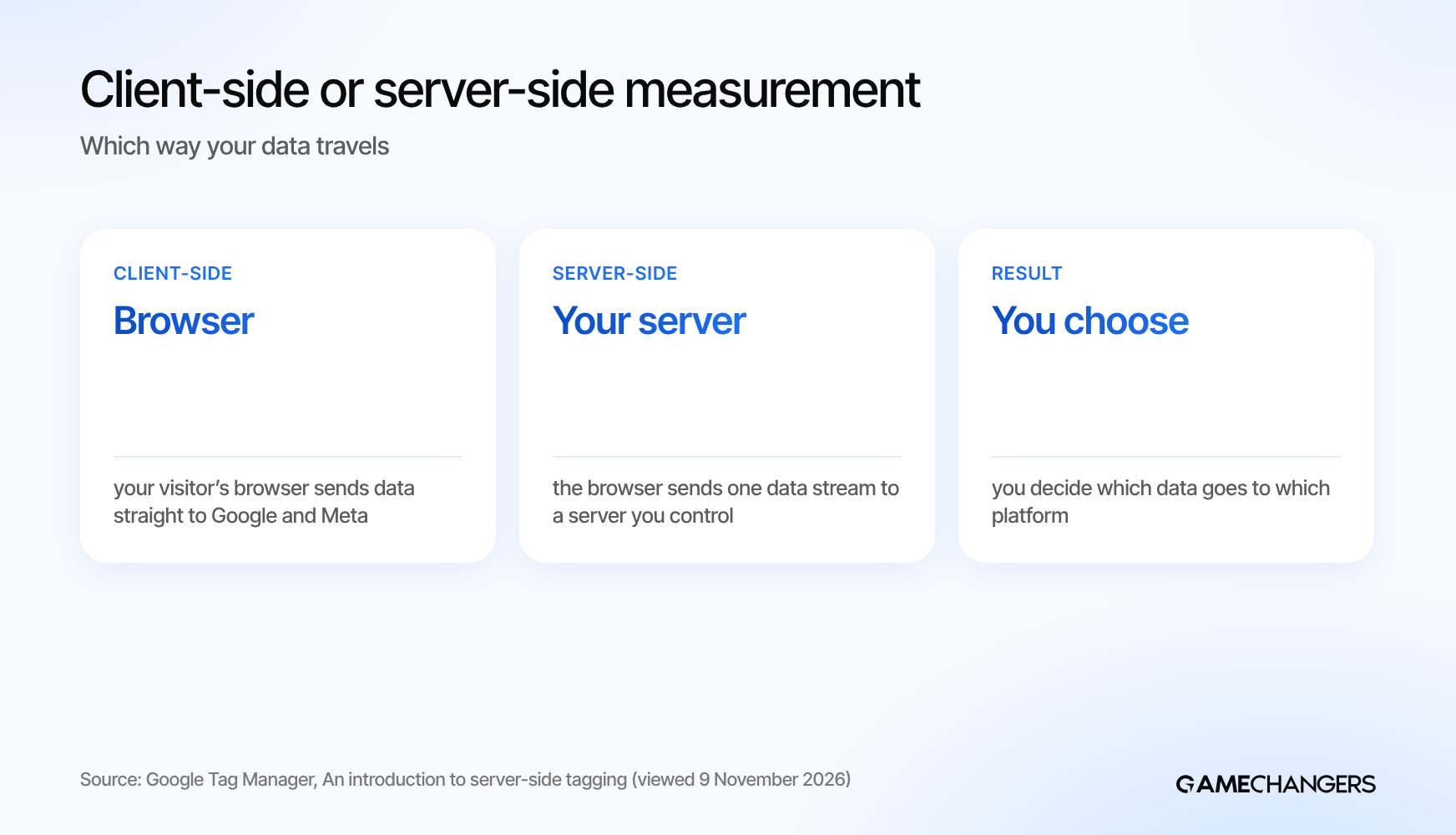
Server side tagging and server side tracking are often used interchangeably. Server side tagging is the technique: your tags run in a server container in Google Tag Manager. Server side tracking is what you do with it: route your measurements through that server. In practice you set them up together.
What are the benefits of server side tracking?
The first benefit is that you miss fewer conversions. Browsers increasingly limit what scripts are allowed to do. According to WebKit, the technology behind Safari, cookies created by JavaScript are deleted after 7 days without a visit. If someone arrives via a recognised tracking link, it is only 24 hours. A returning buyer then looks like a new visitor, and the sale is not linked to your ad.

1. Better data for your ads
Google Ads and Meta steer on the conversions they receive. Meta describes the Conversions API as a connection between your server or CRM and Meta, to target ads better, lower the cost per result and measure outcomes. Also read what Facebook advertising costs and what Google Ads costs.
2. You decide which data you share
Because everything passes through your server first, you can remove or add data before it goes to a platform. Think of removing personal data, or adding the real order value from your till system.
3. Fewer scripts on your website
You replace several tags in the browser with one stream to your server. That saves code the browser has to load. A faster page also helps your conversion; also see our landing page checklist.
What does server side tracking cost?
The costs consist of two parts: the server and the work of setting everything up and maintaining it. For the server, Google itself gives an indication: on Cloud Run each server costs about €40 per month, and Google advises at least 2 servers to prevent data loss during an outage. Google states the amount in dollars; we converted at the ECB rate of 6 November 2026 (1 euro is 1.1165 dollars), which comes to about €81 per month for 2 servers. With heavy traffic Google scales up to 10 servers, which is about €403 per month.
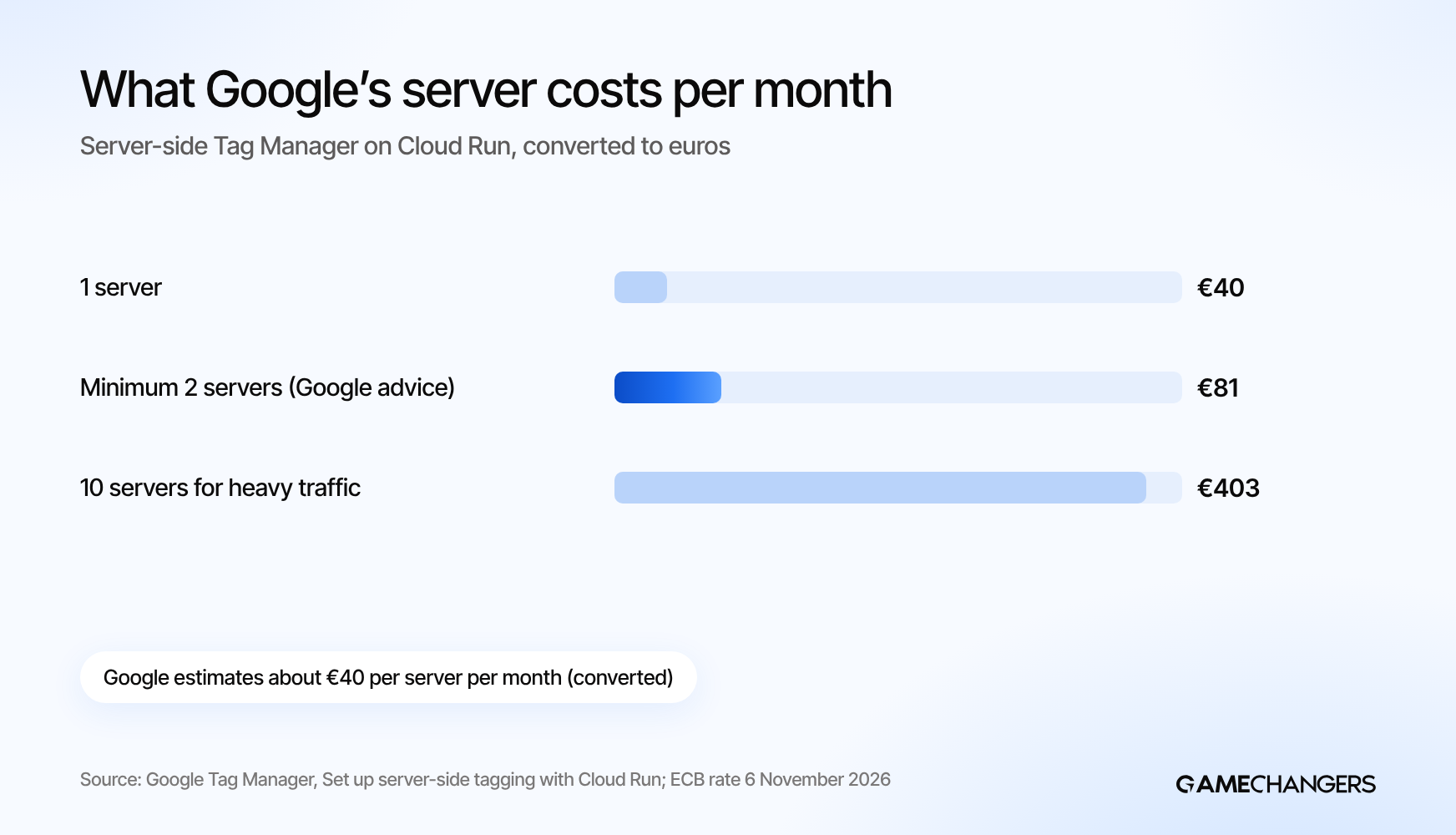
There are also specialised hosting services that manage the server for you, often for less per month at low traffic. Which choice fits best depends on your number of visitors and how many platforms you connect. Most of the cost is usually not in the server, but in setting it up properly, testing and maintaining it.
How do you set up server side tracking?
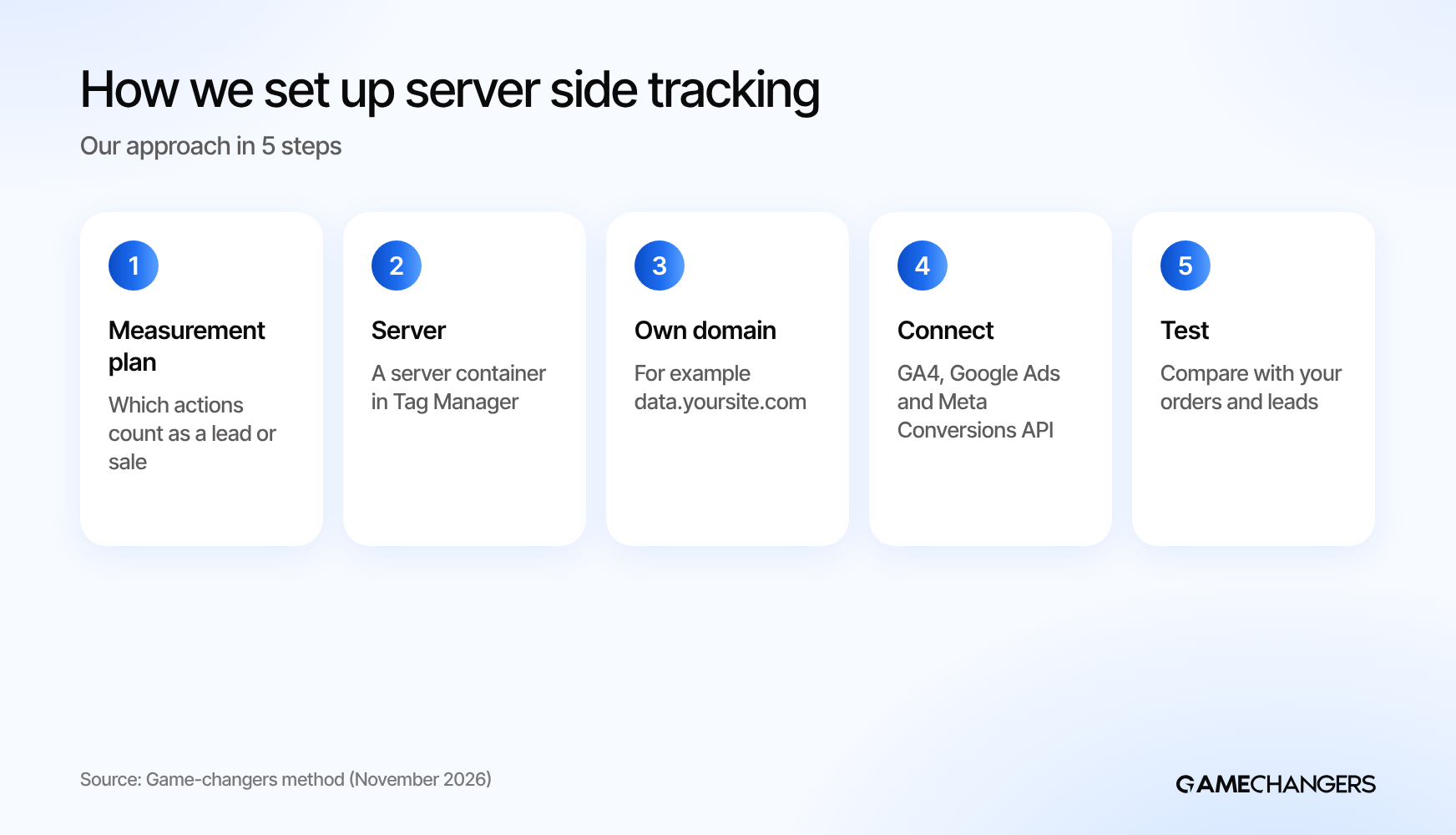
This is how we approach it with our clients, in five steps.
1. Measurement plan
First we define which actions count: a purchase, a quote request, a booked appointment. Without a measurement plan you measure exactly the same mistakes server side as now. Also use our tracking and GA4 checklist.
2. Server
We create a server container in Google Tag Manager and run it on a server, at Google Cloud or another host.
3. Own domain
The server gets an address on your own domain, such as data.yoursite.com. That way the measurement belongs to your own website.
4. Connect
From the server we forward the data to GA4, Google Ads and the Meta Conversions API, and where needed to your CRM.
5. Test
We compare the measured conversions with your real orders and leads. Only when they match do the campaigns start steering on them.
Our research: what Google shows for “server side tracking”
On 9 November 2026 we used DataForSEO to look at the search results for “server side tracking” in Google Netherlands. At the top was an AI answer with an explanation. Of the 9 regular results, 7 were explanations or blogs and 2 were an agency’s service page. None of the 9 showed a price in Google; only the 2 ads did. So searchers get plenty of explanation but little to go on about the cost. That is why we do give Google’s indicative price and our own price here.

What does it deliver?
Good data is the foundation of every campaign. At Rug expertise centrum we connected Meta, YouTube and Google in one funnel, making visible how each touchpoint contributed to every booked consultation. Deurklinkshop achieved the same order value with 4 times less ad spend and made 131% more profit. At CrossFit Climbers Cabin the cost per lead fell from €55 to €9 with Google advertising.

“With almost every new client we see a gap between the sales in the online shop and the conversions in Google Ads or Meta. The algorithm is then steering on half the information. With server side tracking and the Conversions API we give the platforms the sales and leads that actually come in, and you often see the campaigns steer better.”

What does server side tracking cost at Game-changers?
At Game-changers server side tracking falls under Data and tracking. That service starts from €500 per month excl. VAT, for which we work at least 4 hours per month for you. If you also use Google advertising, social media advertising or conversion rate optimisation, data and tracking is included as standard and combining becomes cheaper. There is no set-up fee. Request a free analysis.
Frequently asked questions about server side tracking
What is server side tracking?
Server side tracking means measuring via a server you control, instead of only via your visitor’s browser. The browser sends the data to your server, which forwards it to platforms such as Google Analytics, Google Ads and Meta. That gives you more control and you miss fewer conversions.
What is server side tagging?
Server side tagging is the technique behind server side tracking. Your tags then run in a server container in Google Tag Manager instead of in the browser. That container forwards the data to the platforms you choose.
What is the difference between server side tagging and server side tracking?
Server side tagging is the technique, server side tracking is the goal. With tagging you set up the server container, with tracking you route your measurements through it. In practice you set them up together.
What are the benefits of server side tracking?
You miss fewer conversions due to browser restrictions, you decide which data you share and your ads learn from real sales and leads. You can also remove scripts from the browser, which makes your website lighter.
Why choose server side tagging?
Because browsers such as Safari increasingly limit what scripts are allowed to do. Cookies created by JavaScript disappear in Safari after 7 days without a visit. With your own server you keep more control over measurement.
What does server side tracking cost?
Google’s server costs about €40 per server per month, and Google advises at least 2, so about €81 per month. On top of that come the costs of setting it up and maintaining it. At Game-changers that is from €500 per month excl. VAT, with no set-up fee. Request a free analysis.
How do you set up server side tracking?
You create a measurement plan, run a server container from Google Tag Manager on a server and give it an address on your own domain. Then you connect GA4, Google Ads and Meta, and test the measurements against your real orders and leads.
Does server side tracking work with GA4?
Yes. You send the data from the browser to your server container, which forwards it to Google Analytics 4. That way you can use the same reports in GA4, with data that has passed through your own server.
Does server side tracking work with Google Ads?
Yes. From the server container you forward conversions to Google Ads. That way the algorithm sees more of your real conversions and can steer better on what delivers results.
What is the Meta Conversions API?
The Conversions API is Meta’s connection for sending conversions from your server, website or CRM straight to Meta. Meta uses that data to target ads better and measure results. It is often used alongside the Meta pixel.
Outsource server side tracking or do it yourself?
Doing it yourself is possible if you know Google Tag Manager and cloud servers well. Most of the work is in setting it up properly, testing and maintaining it. Outsourcing prevents you from steering on wrong data for months.
Do you still need a cookie banner with server side tracking?
Yes. Server side tracking does not change the rules on consent. For tracking and advertising cookies you still need your visitor’s consent, even when the data passes through your own server.
Does server side tracking work against ad blockers?
Partly. Because the data goes through your own domain, fewer measurements are blocked than with scripts from known tracking domains. Some blockers also recognise server measurements, so it is never complete.
Does server side tracking work with Shopify or WordPress?
Yes. For Shopify and WordPress there are integrations to send the data to a server container. The set-up differs per platform, but the principle is the same.
Does a small business need server side tracking?
If you advertise and want to know which campaign delivers customers, it helps even with a smaller budget. With few conversions, every missed measurement weighs heavily. Start by putting your orders next to your conversions to see how much you miss.
What does server side tracking cost at Game-changers?
Server side tracking falls under our Data and tracking service, from €500 per month excl. VAT with at least 4 hours of work per month. If you use another service, data and tracking is included as standard. There is no set-up fee. Request a free analysis.
Sources
Google Tag Manager, An introduction to server-side tagging
viewed 9 November 2026
Google Tag Manager, Set up server-side tagging with Cloud Run
viewed 9 November 2026
WebKit, Tracking Prevention in WebKit
updated 27 April 2023, viewed 9 November 2026
Meta for Developers, Conversions API
viewed 9 November 2026
European Central Bank, euro-dollar rate
6 November 2026
DataForSEO SERP API, own measurement Google Netherlands
9 November 2026
Ahrefs Keywords Explorer, Dutch search volume
9 November 2026
Over de auteur
About the author
Annefleur van Osta
Online marketing strateeg bij Game-changers. Schreef dit artikel en houdt de prijzen en bronnen actueel.
Online marketing strategist at Game-changers. Wrote this article and keeps the prices and sources up to date.